Pages

I love rice and so does my husband. We try to find different ways to prepare and enjoy this wonderful food. Through time, we found hundreds of recipes, some simple and some exotic, and have enjoyed preparing them. We've found some real winners, which I have published on this blog and some that are not so great, which are in my personal "do not" repeat folder. I have created this site to share those memorable dishes - which are all about this wonderful food called "rice".
Showing posts with label Philippines. Show all posts

Fresh Lumpia (Lumpiang Sariwa)

There are so many versions of egg rolls.  Different parts of Asia have different versions.  The Philippines is no different.  Depending what province you are in, they have their own version.  Most egg rolls are fried, but there are some that are considered fresh.  This is most popular during special events, holidays and fiestas in the Philippines. Depending where you are at, the ingredients could change accordingly.  This one is my grandmother's recipe with a slight variation; she likes to add garbanzo beans to hers.  Fresh lumpia wrapper can be found in the freezer section of most Asian grocery stores. 


Ingredients:
1/2 lbs raw shrimp (shelled, deveined and chopped)
1/2 lbs ground pork
1 jicama (sliced into match sticks)
1 cup bean sprouts
2 cups napa cabbage (cut into strips)
2 cups green beans (roughly chopped)
12 red or green leaf lettuce leaves
4 cloves garlic (minced)
1 medium onion (minced)
Slat and pepper
Fresh lumpia wrappers
2 tblsp canola or olive oil

In a large fry pan or saute pan, heat the oil.  Add onions and garlic.  Saute for approximately 3 minutes.  Add the ground pork.  Continue cooking for another 10 minutes until pork is done.  Add the shrimp and continue to saute for another 4 minutes or until shrimp is pink and opaque.  Add green beans, jicama,  and napa cabbage.  Saute for another 5 minutes and season with salt and pepper to taste.  Remove from heat and drain well using a colander. 

Set a small bowl of water next to a plate, lay a wrapper and place a lettuce leave on with the stem to the center of the wrapper and the leafy part extending slightly over the edge of the wrapper.  Put 2 tablespoon of the mixture onto the leave within the wrapper. Lay one side of the wrapper over the filling and gently roll tightly without tearing.  Before reaching the end, pull the bottom to the center and continue rolling until you create a tight cone with the leafy end open. Serve with lumpia sauce. Recipe below:

Lumpia sauce:

4 tblsp cornstarch
1/3 cup brown sugar
1/4 cup soy sauce
1 1/2 cup chicken or vegetable broth
10 garlic cloves (minced)
1 tblsp canola or olive oil

In a sauce pan, heat oil and saute garlic for approximately 1 minute.  Add sugar and broth.  In a small bowl combine soy sauce and cornstarch until cornstarch is disolved.  Add this to the sauce pan.  Cook for approximately 5 minutes until sauce comes to a low boil and starts to thicken.  Spoon over fresh lumpia.

Hocks Braised with Sugar (Pata Estofado)

This is a great Filipino recipe.  Cooking time is pretty extensive.  Preparation is easy, pig hocks need a lot of time to braise to make them tender, so the cooking time takes 3-4 hours and does require you to check to ensure that all the liquid does not completely evaporate.  You will need to replenish to allow for the cooking time.
Dried lily blosssoms can be found at any Asian grocery stores.


Ingredients:

2-3lbs pig's hocks
2 1/2 cups apple cider vinegar
2 cups water
10 peppercorns
2 cup brown sugar
1 cup soy sauce
1 cinnamon stick
2 onions (quartered)
10 cloves garlic (minced)
8 tblsp oil (for frying)
1 cup dried lily blossoms (add more if desired)
Salt and pepper to taste

In a large stock pot, heat 3tablespoon of the oil.  Add onions and saute for approximately 3-4 minutes.  Add minced garlic and cinnamon stick.  Continue to saute for another 2 minutes.  Remove pot from heat and add the rest of the ingredients except for the oil and dried lily blossoms.  Allow hocks to marinade for an hour.  Heat oil a large deep skillet.  When oil is hot, remove hocks, reserve the marinade in the pot.  Fry hocks on each side to brown.  Approximately 5 minutes on each side.  Do not crowd hocks when frying.  Continue until all the hocks have been browned. Move hocks back into the stock pot and place on the oven set at medium-high heat.  Allow to boil, reduce heat to a low boil and continue cooking for another 2 1/2 hours.  Check pot occasionally to ensure braising liquid has not evaporated.  If braising liquid is low, add another cup each of water, apple cider vinegar and sugar and a 1/2 cup of soy sauce.  Season with salt and pepper to taste and continue with the cooking process. You can increase sugar if you want it a little sweeter.  This dish is more to individual taste.  During the last 30 minutes of the cooking process, add the lily blossoms.  Test the hocks for tenderness by spearing with a fork, meat is tender if fork slides in without any effort.

Pile a scoop of rice into a large bowl.  Ladle sauce, hocks and lily blossoms over the rice and enjoy!

Nilagang Manok (Filipino Chicken Vegetable Soup)

This is not your ordinary chicken vegetable soup. As with many island cultures, soup is very big in the Philippines served over rice.  You can use beef instead of chicken if you prefer.  There are no strict rules on the vegetables either.  Use whatever yo want, when I cannot find bok choy, I use cabbage. Cheyote is good with this and I have seen potatoes as well.   This is very popular in many Filipino homes since it is an easy meal to prepare with lots of vegetables.  The chicken broth just feeds your soul.  Now, I did make some changes to the original recipe.  I find I like more seasoning in mine.  I played around until I came up with this version.


Ingredients:

1-1/2lbs chicken pieces (breasts, thighs, drumsticks, etc.)
2 cloves garlic (minced)
1/2 inch ginger (minced)
2 small stalks celery (whole w/leaves)
6-8 peppercorns
3-4 carrots (peeled and cut)
1 small onion (peeled and quartered)
8 cups chicken broth
1 bay leaf
1/2 lb of green beans
8 baby bok choys (cleaned and removed from core)
2 tblsp canola or olive oil
Salt to taste

In a large stock pot, heat the oil, then add onion, garlic, bay leaf, peppercorn and ginger.  Cook while stirring for approximately 2-3 minutes.  You want the onions to be a little soft and translucent, but do not want the garlic or ginger to brown.  Add 8 cups of chicken broth, celery, carrots and chicken. Allow to get to a roiling boil, then reduce the heat to continue a low boil for approximately 30 minutes or until chicken is cooked through.  Remove and discard celery stalks and bayleaf.  Season with salt and add green beans; continue to cook for another 5 minutes.  Add the baby bok choy and continue cooking for another 5 minutes.  Taste and season with salt if needed.  In a bowl, add rice and spoon nilaga over the rice. Don't forget to be generous with the broth.  You can season to taste with patis (fish sauce).  Enjoy!

Eggplant Adobo Style

We love eggplant at my house. I try to find recipes out there that utilizes this great night shade.  There are so many different types of eggplants, so you know there will be numerous ways to prepare.  Filipinos love "adobo".  They prepare just about anything adobo style.  So, when I found this recipe, I was so excited to make it.  What a find.  If you love Filipino style adobo and eggplant, this is a perfect marriage.


Ingredients:

3-4 Japanese eggplants
5 cloves of garlic (crushed whole)
1/2 cups chicken or pork broth
3 tblsp soy sauce
1/3 cup white wine vinegar or coconut vinegar
1 tsp sugar
1 tsp oyster sauce
3 tblsp canola or olive oil
Salt & pepper to taste
1 tsp canola or olive oil (for sauce)

Slice eggplants diagonally.  Heat the oil in a frying pan.  When hot, fry the eggplant slices until brown and semi-soft but still a little firm.  Remove the cooked eggplant to a paper towel to absorb any excess oil.  Continue cooking until all the eggplant slices have been fried.  Do not crowd.  Eggplant tends to absorb the oil, so add additional oil to the pan when needed.

In another saucepan, heat 1 tsp of oil.  Add the garlic, stirring frequent, cook for 1 minute. Do not allow it to burn.  Add vinegar, soy sauce, broth and lots of pepper.  Bring to a boil then reduce to simmer for 5 minutes.  Add the eggplant, season with salt if necessary.  Continue to cook for 5 minutes, turning the eggplants occassionally.  Serve hot with jasmine or basmati rice.

Embutido

Okay, this is seasoned ground pork that has been rolled into a log and then baked.  The ingredients sounds kinda strange when you think about combining them, but actually, this is absolutely DELICIOUS!  This is my mother's recipe which I have taken some liberties ( I know she will yell at me later).  I've made two different versions, one using Spanish chorizo and another using andouille sausage.  The Spanish chorizo is part of the traditional recipe.  The andouille sausage adds a whole 'nother level.  If you like your foods with some spice, I highly recommend the andouille sausage, if not, go for the traditional Spanish chorizo.  Remember, do not use Mexican chorizo, totally different taste and seasoning.  It will not work on this dish.  This actually is not hard to make, just mix all the ingredients, roll into a log, wrap and then bake.


Ingredients:

1 1/2- 2 lbs of ground pork
1 cup bread crumbs soaked in 3/4 cup milk
2 Spanish chorizo or andouille sausage (cut into chunks)
2 eggs (beaten)
4 tblsp sweet pickle relish
4 tblsp raisins
1 small can (6oz) tomato paste
1 cup pork or chicken broth
2 tblsp of light brown or raw sugar
2 tblsp canola or olive oil
Salt and pepper
2 sheets of aluminum foil

Heat oven to 350 degrees.  In a food processor, add the chorizo/sausage and raisins. Process until minced but not pureed.  In a large mixing bowl, add the ingredients from the food processor, ground pork, soaked bread crumbs, eggs and sweet relish.  Mix well and season with salt and pepper.  On one of the aluminum sheets, place half of the mixture and proceed to stretch out and create a log.  It does not have to be perfectly round.  Wrap the log with the foil and crimp the ends closed. Place foil wrapped log in a baking dish.  Do the same withe other half.  Place the second foil wrapped log in the same baking dish.  Place in the heated oven and bake for 1 hour.  Remove the embutido from the oven and reserve the liquid at the bottom of the dish. 

Unwrap the embutido and remove the foil.  Place the rolled meat back into the baking dish.  Set the oven to broil - Low .  Brush each log with the oil and return to the oven for another 10 minutes to brown.  Remove from the oven and allow to rest for 5 minutes before slicing. 

To make the sauce, in a sauce pan, add the tomato paste, sugar and broth.  Mix well to make a smooth sauce, and heat through using medium heat.  Pour the reserved liquid from the baking dish into the sauce.  Stir the sauce until the liquid is well incorporated.  Continue to heat until sauce is hot, season with pepper to taste.  Serve sauce with the sliced meat.  Enjoy with your favorite steamed jasmine or basmati rice.

Chicken Cooked in Coconut Milk (Manok sa Gata)

The combination of chicken and coconut milk is very popular in the pacific islands.  There are several versions depending on where you look (Thailand, Indonesia, Philippines, etc.)  This is one of our favorites at home.  This is even better the next day, if it lasts that long.


Ingredients:
1 1/2 lbs of chicken (thighs, legs and breasts)
3/4 cup vinegar
2 1/2 cups chicken broth
1 inch ginger (minced or paste)
6 cloves garlic (minced)
1 13oz can coconut milk
3 tblsp sugar
Salt and Pepper
1 tblsp canola or olive oil

In a deep pot or sauce pan, heat the oil.  Add the ginger and garlic and saute for approximately 1 minute. Add the chicken pieces and cook for another 3 minutes.  Add the vinegar and chicken broth.  Season with salt and lots of pepper, then add the sugar.  Reach to a boil, then reduce to a low boil.  Cook for 30 minutes. Watch carefully to ensure the liquid does not dry out.  Add the coconut milk and continue to cook in a low boil for another 20-25 minutes.  Season with salt and pepper if necessary.  Spoon over rice with a generous amount of the soup.  Enjoy!

Bola-Bola (Sweet and Sour Meatballs)

This is a very beautiful and colorful dish.  It is a great hit with kids and people who are picky about Asian foods.  This also quick and easy to fix and gets a lot of ooohhhs and ahhhhs, plus it taste fabulous.  You can do the quick version by replacing the home made meatballs with pre-made from the grocery store.  I recommend IKEAs. If those are not available, those from the grocery store works, just make sure you do not get the Italian style.  The seasoning does not work with this dish.  If you have time, home made is the best. I used different color bell peppers, but you can use one color if you prefer.


Ingredients:
1/2 cup soy sauce
1/2 cup coconut vinegar or apple cider vinegar
1/2 cup water
3/4 cup sugar
2 tblsp corn starch
3 tblsp olive or canola oil
3-4 stalks of celery (sliced diagonally)
4 roma tomatoes (cut in quarters)
1 medium onion (sliced)
1 large bell pepper or 1/2 of 3 different colors (cut in strips)
1 lb meatballs (home made or pre-made)

Meatballs:
1/2 lb ground beef
1/2 lb ground pork
1 tblsp garlic powder
1 tsp sugar
salt and pepper
1 cup olive or canola oil

For meatballs:  combine all the ingredients except for the oil.  Mix well.  Pinch off approximately 1 tblsp and form into a ball in your palm.  Repeat until you have made all the meatballs.  Heat the 1 cup of oil on high in a deep sauce pan. Fry meatballs in batches until brown and done.  Remove from oil and set aside.

In a large pot or dutch oven.  Pour the vinegar, soy sauce, water and sugar.  Allow to simmer until sugar disolves.  Add the meatballs and set temperature to low.   In a separate frying pan, heat 1 tblsp of the oil.  When oil is hot, add onions and celery.  Season with salt and pepper.  Stir fry for approximately 2 minutes.  Transfer to pot with meatballs and sauce.  Heat another tblsp of oil in the frying pan.  Add the bell peppers, season with salt and pepper, and stir fry until crisp tender for approximately 2 minutes. Transfer to the pot with the meatballs and sauce.  Heat the last tblsp of oil, add the tomatoes and season with salt and pepper.  Stir fry until slightly scorched, approximately 1-2 minutes. Transfer to the pot.  Stir the vegetables with the meatball and sauce until all the ingredients are well incorporated.  Increase the heat to allow a low boil.  Place the cornstarch into a small bowl.  Add a little water to make a watery paste.  Make sure the cornstarch and water are mixed well with no lumps.  Pour the cornstarch mixture into the pot directly on the sauce.  Stir well to ensure the cornstarch is well incorporated.  Continue to boil for another 4 minutes to allow the sauce to thicken.  Stir occassionally during this process.  Once sauce has thickened, serve over steamed rice and enjoy.  With the sweet and sour sauce, this is great with shrimp fried rice.

Afritada (Filipino Pork and Chicken Stew)

Spain occupied the Philippines for over 400 years.  Not surprising then to find foods with a lot of Spanish influence.  Afritada reflects that Spanish influence.  This can be made with just chicken or just pork.  We love the combination at my house since it covers everybody.  My husband loves the pork and my mother loves the chicken. So, you can't go wrong.  I made some changes to make it easier. 


Ingredients:

1lb of chicken parts (breast, thighs, wings, etc.)
1lb pork shoulder or butt (cut into chunks)
4 potatoes (cut into chunks)
1 large onion (chopped)
1 cup chicken stock
1-2 bay leaves (1 large or 2 small)
4 carrots (peeled and cut into chunks)
1/2 cup frozen peas
1 green bell pepper (cut into bite size chunks)
1 red bell pepper (cut into bite size chunks)
1 20oz can of tomatoes (roughly chopped in food processor)
1 20oz can of stewed tomatoes (roughly chopped in food processor)
1/4 cup canola or olive oil
Salt and pepper
1 small can of garbanzo beans (drained and rinsed) - optional

In a food processor, roughly chop the canned tomatoes.  Process until you get the texture you want.  Short pulses for some chunks, or longer processing if you want more of a puree.  Do the same with the stewed tomatoes.

In a large pot or dutch oven, heat an 1/8 cup of the oil in high heat.  Add the pork chunks and lightly brown for approximately 3 minutes.  Remove from pan and set aside.  Do the same with the chicken, and add that the pork.  In the same pot, add the rest of the oil and the potatoes.  Cook the potatoes for approximately 4 minutes until some of the sides have browned.  Remove the potatoes and set aside.  Reduce the heat to medium-high and add the chopped onions and the bay leaf to the hot oil in the pot. Cook the onions until they are translucent, approximately 3 minutes. Add the canned tomatoes and stewed tomatoes.  Continue cooking stirring constantly until tomatoes are heated through.  Add the pork, chicken and potatoes back into the pot.  Continue stirring until all the meat and potatoes are well coated with the tomatoe/onion mixture.  Add the carrots, peas and the chicken broth; continue stirring.  Cover and reduce to medium heat and keep at a low boil.  Keep covered and cook until chicken, pork and potatoes are tender, continue stirring to ensure that it does not stick to the bottom of the pan and burn; this should take approximately 30 minutes.  Season with salt and lots of pepper.  Add the both the red and green bell peppers. If using garbanzo beans add that at this time.  Continue cooking for another 10 minutes to allow peppers to cook but still have a crunch.  Taste for seasoning.  Add salt and pepper if necessary.  Serve hot over steamed rice.

Celebrating Philippine Independence - June 12th

On June 12th, the Filipino community in the Dallas/Ft Worth area celebrated their independence day with a formal dinner, dancing and pageant.  The Philippines celebrated its 112th year of freedom.  To recognize this wonderful event, I decided to dedicate the month of June to share the different foods of my country.  Though only half Filipino, I am still proud to call it my own.

In 1898, the United States bought the Philippines from Spain for $20 million dollars ending the Spanish American War. On June 12, 1898, Emilio Aguinaldo led the Filipinos to declare their independence against the United States.  This declaration of independence was opposed by the United States, leading into the guerilla war in the Philippines.  Emilio Aguinaldo was arrested but, soon declared his allegiance to the United States.

In 1941, Japan attacked Pearl Harbor declaring war on the United States.  Japan then invaded and occupied the Philippines.  Those were grueling times for the Philippines.  In October 1944, General MacArthur and President Osmena returned and liberated the Philippines from Japan.

On July 4, 1946, the United States gave the Philippines their independence. They then became Republic of the Philippines.

In 1961, Diosdado Macapagal won the presidential election.  He changed the independence day from July 4th to June 12th, the day Emilio Aguinaldo declared independence from Spain in 1898. Emilio Aguinaldo was the guest of honour on the first Independence Day celebration in 1962.

If you want to see and try the different Filipino foods, click on "Philippines" on my "Food Search" to find all the recipes I have personally prepared.

Mabuhay!

Tamarind Pork and Vegetable Soup (Sinigang na Baboy)


Soups play a major role in the Philippines. Combined with rice, it is a substantial meal.  Sinigang is the national soup. There are so many variations depending on the region, and in the Philippines, there is a lot.  I had previously blogged a shrimp version.  This is the pork version, which is the ultimate favorite at my house.  This is where my husband stands by my shoulder going "is it done yet?" Another dish that does not last at my house.

Ingredients:
8 cups of water
2 pork boullions
2 tblsp tamarind paste
2 lbs pork butt, shoulder, pork belly or pork ribs ( a little fat makes this very flavorful)
4 tomatoes (quartered)
1 cup daikon radish (cut into chunks)
1 bunch water spinach or regular spinach
1 cup green beans (trimmed)
1 Japanese eggplant (cut into chunks)
Salt or fish sauce to taste
1 anaheim or chillie pepper (optional)

Cut pork into chunks.  In a large stock pot, add water, boullions, tamarind paste, tomatoes, pork, and daikon.  Bring to a full boil.  Reduce heat to a low boil and continue to cook for 45 to 60 minutes.  The longer you cook the pork the more tender.  Taste and season with salt or fish sauce. Add the green beans and eggplant. If you want to make a spicy version, add the pepper at this time.  Continue at a low boil for 5-7 minutes, until eggplant is tender.  Add the water spinach and continue cooking for another 5 minutes.  If using regular spinach instead.  Turn the heat off after the egg plant is done, then add the spinach. Stir the soup, taste and reseason with salt or fish sauce if needed.  Allow the spinach to wilt.  Serve hot over rice.  Yummmmm!!!!

NOTE: Fish sauce can be purchased at any Asian grocery store.  Use any vegetables that you have on hand: brocolli, cabbage, okra, carrots, etc.  You cannot go wrong.

Filipino Barbeque (Inihaw)

During picnics and summer events, this is very popular with the Filipinos. Majority of the prep-time is in skewering the meat through the bamboo spears.  The dish itself is very simple with very few ingredients, but oh so worthwhile after you barbeque them on the grill. Interstingly enough, the fattier the meat the more tender and less dry.
Ingredients:

2 lbs of pork butt or picnic (sliced in strips)
1/2 cup vinegar
1/4 cup sugar
8 garlic cloves (minced)
2-3 tblsp canola or peanut oil
Salt and pepper
bamboo Skewers

Slice the pork into strips approximately 1/4 -1/2 inch thick.  Do not slice too thin or it will dry out during the cooking process.  In a glass or non-reactive bowl, add the pork, vinegar, sugar, and garlic.  Using your hand, mix well.  Season with salt and lots of pepper.  Mix well, cover and refrigerate for at least 4 hours or over night.

Soak bamboo sticks in water for at least 20 minutes.  Skewer the pork into each bamboo stick.  You can either skewer the pork on 3/4 of the stick or if you want more stick to handle, then only skewer the top half of the stick.  After skewering, brush the pork lightly with oil.  Heat the barbeque grill on medium and cook each side of the pork for approximately 8-10 minutes. This will depend on the thickness of the cut of the meat.  Turn the skewered meat over and continue to grill on the other side for another 4-6 minutes.  Do not allow the meat to burn or get dry.  If it appears dry, brush with a little more oil.  Serve hot with rice and pickled salad (achara).

NOTE: This can also be prepared in the oven using the broiler.  

Green Papaya Salad (Achara)

This a very popular pickled salad in the Philippines.  It is usually served with rice and your favorite grilled or fried fish and meat.  Try it with the Filipino fried chicken or barbeque.  It is so easy to make.  You can find green papayas at most Asian grocery stores.  Adding the red chillies provide some heat.  Reduce or add the number of chillies to adjust to your taste.  They can be removed if you do not want it spicy.


Ingredients:
1 green papaya (cut into julienne strips)
1 carrot (cut into julienne strips)
4 cloves garlic (minced)
1/2 cup apple cider vinegar or coconut vinegar
1-2 red chillies (cut into very thin strips)
1/2 red bell pepper (cut into julienne strips)
1/2 cup raisins and/or sultanas
3 shallots (minced)
1 inch ginger (minced)
1/4 cup sugar
1 tsp salt

In a small sauce pan, heat the vinegar, sugar and salt.  Once sugar and salt has disolved, remove sauce pan from heat and allow to cool. 

In a separate bowl, combine the rest of the ingredients.  Pour sweet vinegar over the vegetables in the bowl and mix well.  Store in an airtight container for at least 4 hours or overnight.  Serve with rice and your favorite fried or grilled foods.

Filipino Beef and Onions (Bistek)

This is so yummy.  Another recipe that when I make at home does not last very long.  This is one of my mother's favorites as well.  It so simple to make and quick.  This can be prepared while waiting for the rice to cook. If you love liver and onions, this is a great recipe. Just change the beef for thinly sliced liver.


Ingredients:
2 lbs beef skirt or sirloin (thinly sliced)
6 tblsp soy sauce
Juice of 3 lemons - separate 1 of lemon juice
2 onions (sliced into rings)
3/4 cup of water
1 tblsp oyster sauce
Salt and pepper
1 tblsp flour or corn starch
3 tblsp olive or canola oil

In a glass or non-reactive bowl mix beef, 3 tblsp soy sauce, juice of 1 lemon and flour. Let sit for 15 minutes.  Heat oil in a deep saute or frying pan.  Add the onions and season with salt and pepper.  Fry onions until translucent, approximately 5 minutes.  Remove from the pan and set aside.  Add the sliced beef in batches to allow it to brown. Remove and set aside, continue cooking until all the beef has been browned.  Return all the beef back into the pan and add the onions.  Add the  remaining soy sauce, the juice of the last 2 lemons and water.  Allow to slowly boil.  Season with lots of pepper or to taste.  Add the oyster sauce and continue slow boiling for another 5 minutes. If the soup is too tangy, add 2-3 tablespoon of water and continue to slow boil for another 2-3 minutes.  Taste and season with salt and pepper if needed.  Serve hot over rice.

Filipino Menudo (Diced Pork Stew with Potatoes)

Okay, let me start by saying "this is nothing like the Mexican version." Filipino Menudo has a lot of Spanish influence.  This is especially wonderful the next day.  It does take some time for the cooking process but so worth it.  My husband absolutely loves this and cannot wait for me to make it.  The challenge is letting it sit for a little while to let the flavors marry.  Not possible at my house.


Ingredients:

1 lb pork butt or shoulder (cut in large sections)
1 lb calf or beef liver (cut into bite size pieces)
3 large tomatoes (chopped or minced)
2 1/2 cups potatoes (cut into bite size pieces)
1/2 cup canned chick peas (drained)
1/2 cup frozen peas
1 large onion (minced)
4 cloves garlic (minced)
2 cups water (from boiled pork)
1 roasted red bell pepper (diced) or 3oz jar of pimiento
1/2 cup raisins
1 tblsp sugar
2 tblsp olive or canola oil
salt and pepper

In a deep pot, fill about half way with water, add the pork and season with salt.  Boil for 45 minutes until pork is tender.  Strain pork reserving 2 cups of the broth and set aside to cool.  When cool, chop pork into bite size pieces.   

In a large deep pan or pot, heat oil.  Add potatoes and cook until tender and lightly brown.  Add onion and garlic.  Cook until onion is translucent, then add the tomatoes and sugar.  Continue cooking stirring constantly until tomatoes soften approximately 3-4 minutes.  Add the pork and liver.  Continue stirring until liver browns and is cooked.  Add the reserved 2 cups of pork broth, peas, raisins and chick peas.  Allow to gently boil for another 12-13 minutes.  Liquid will reduce; season with salt  and pepper.  Add the roasted bell peppers or pimientos and continue to cook for another 8 minutes.  Serve hot over rice.

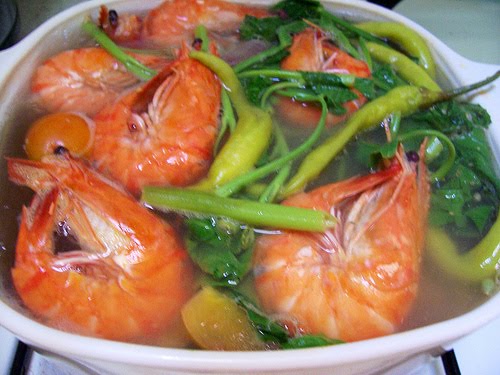
Filipino Sour Shrimp Soup (Sinigang na Hipon)


In the Philippines, like many in the Pacific Islands, soups play a main role in their food culture.  These soups are poured over rice, making a substantial meal.  This is a very versatile soup.  The broth, tomatoes and shrimp are the base.  There is no limit to the vegetables.  Use whatever you have on hand (brocolli, carrots, cabbage, okra, etc.)  You can also make it spicy by adding green chillies. Different regions and families have numerous versions.  Try it out using the basics and then play around with what suits you. 

Ingredients:

1 lb shrimp in shells
8 cups water
2 fish or shrimp bouillion cubes
2 tblsp tamarind paste
2 tomatoes (quartered)
1 small bunch fresh spinach leaves (trimmed)
1 cup green string beans (trimmed)
1 medium onion (quartered)
1 cup dikon radish (cut in chunks)
2-3 green chillies (optional)
Salt or Patis (fish sauce)
Steamed jasmine or basmati rice

In a deep pot, add water, bouillion, tamarind paste, onion, tomatoes and dikon radish.  If using the green chillies, add those at this time.  Bring to a boil for 15-20 minutes until daikon becomes translucent, stirring occasionally.  Add the green beans and continue to cook for another 10 minutes at a low boil.  Add the shrimp and cook for another 5 minutes.  When the shrimp becomes a dark pink and opaque, season with salt or patis and the fresh spinach.  Turn off the heat and allow the spinach leaves to wilt approximately 3 minutes.  Scoop rice into a deep bowl.  Add shrimp and vegetables with plenty of broth for a soupy consistency.  Season with additional salt or patis if needed. Enjoy!

Note:  For additional variety, you can add fresh fish (i.e. trout, sea bass, cod, etc.)  Change out the vegetables if you like. This is great with eggplant and okra.

Clams With Spinach and Chayote


This is one of those comfort foods that we absolutely love at home.  There are several versions of this depending on what part of the Philippines you are from.  The original recipe calls for chicken with chicken broth, but I thought I would try it with clams and yummmmmm.  If you do not like clams, then try it with chicken and chicken broth. . 

Ingredients:

1 lb of small neck or manila clams (scrubbed and cleaned or frozen)
1 medium onion (sliced)
1 inch of ginger (sliced in match sticks)
3 cups of fish or clam broth
1 chayote (peeled; remove seed and cut into bite size pieces)
1 small bunch of fresh spinach leaves (clean and trimmed)
Steamed white or brown rice to serve over.
2 tblsp olive oil
Salt and pepper

Heat olive oil in a dutch oven or stock pot.  Add onions and chayote.  In medium heat, stir occasionally until onions become translucent - approximately 5 minutes.  Add the ginger and continue cooking for another 2 minutes to release the flavor of the ginger.  Add the broth and bring to a boil; then reduce the heat to a simmer or lightly boil to allow the chayote to tender for another 8 minutes.  If chayote pieces are large, this will take a longer cooking time.   Season with salt and pepper then add your clams.  Continue cooking until all the clams open. If you are using fresh clams, discard any that are still close.  Add the spinach and stir it into the soup mixture.  Turn off the heat and allow the spinach to wilt.  In a deep bowl, add a scoop or two of rice and top it with the clams and vegetables.  Be very generous with the soup or broth.  Enjoy!

Pork and Chicken Adobo


This is probably the most world known Philippine dish.  Even the Neiman Marcus cookbook has a recipe.  I have never met an American who did not swoon over this dish or when they find out my heritage, wanted to let me know that they have had adobo and how wonderful this is.  Though Mexico has adobo, this is very different from their version.  If you have never tried any of the dishes of the Philippines, start with this first, you will absolutely fall in love with the country when you do.

Ingredients:

1lb boneless pork shoulder (cut into large chunks)
1lb chicken thighs and/or drumsticks
10 cloves of garlic (crushed whole)
1 1/2 cups chicken or pork broth
1/3 cup soy sauce
2/3 cup white wine vinegar or coconut vinegar
2 tblsp sugar
2 tsp of black pepper
2 tblsp oyster sauce
1 Bay leaf
2-3 tblsp canola or olive oil

In a large dutch oven or pot, add all the ingredients except for the oyster sauce.  Turn the heat up and allow to boil.  Reduce to a simmer and cover; add the oyster sauce.  Allow to cook for 1 hour (check occassionally and stir) until meat is tender and liquid has reduced. Do not allow the liquid to go completely dry.  

In a separate pan, add the oil and heat.  Remove the chicken and pork pieces from the pot. Reserve the cooking liquid. Fry the meat pieces in the pan until it browns turning the meat continuously to create a nice crisp skin.  Since the meat is already done, do not over fry.  You just want to add a nice crisp outer layer.  Remove the meat from the pan and into a plate.  Spoon rice into a bowl, add the pork and chicken piece, pour some of the cooking liquid over the meat and rice.  Enjoy!

Note: In many Philippine households, the meat is not fried but enjoyed directly from the pot and over rice.  You decide.

Filipino Blood Stew (Dinuguan)

Many cultures use blood in their cooking (the Germans have blood sausage).  In the Philippines, a stew is created using blood as well.  My husband (an American from Ft. Worth) actually loves this stew when the weather is cold or rainy.  This is one of those recipes that you adjust according to taste.   If you are the adventurous type try it out.  If you want something spicier, use a hotter pepper (green chillies).  Pig's blood can be purchased at any Asian grocery store. This is a perishable item. Use the blood within 24 hours. 


Ingredients:

1 16oz container of fresh pig's blood
1lb of pork butt or shoulder (Cut in large chunks)
8oz of beef or calf liver (cut into small bite size pieces)
1 medium onion (minced)
4 cloves garlic (minced)
1 tsp dried oregano
1 bay leaf
2 tblsp sugar
1 1/2cups pork stock
1 cup apple cider vinegar or coconut vinegar
4-5 whole peppercorn
1 small banana pepper or anaheim pepper
2 tblsp olive oil
Salt and pepper

In a stock pot, fill about half way with water.  Add salt, peppercorn and pork butt/shoulder.  Allow to boil until tender, approximately 1 hour.  Watch to make sure it does not run out of liquid.  Add water when needed.  When done, remove pork and place on chopping board.  Reserve the stock.  When cool enough, cut the pork into small bite size pieces. Set aside.

In a large pot or stock pot, heat oil. Add onions and garlic, and banana/anaheim pepper.  Cook for 3-4 minutes until onions are translucent.  Add oregano and bay leaf. Continue cooking, stirring constantly for another minute. Add the pork and liver.  Continue stirring and allow liver to cook thoroughly.  Add vinegar, sugar, salt and pepper.  Allow to gently boil.  In a food processor or blender, add the blood and 1/2 cup of the pork stock.  Turn on the blender and mix until blood is no longer congealed and is liquified. Add the liquid from the blender into the pot.  Add the remaining stock and continue to gently boil for another 15 minutes.  The longer you boil, the vinegar will tone down.  Taste the stew, you can adjust the tanginess at this point.  If you like it tangier, add a 1/4 cup of vinegar. If you wish for a sweeter flavor, add another tablespoon of sugar.  Season with salt and pepper.  Continue cooking for another 10 minutes. Serve over rice.

Filipino Pork Risotto with Fried Liver (Aroz Valenciana)

Aroz Valenciana is usually made during the holidays in the Philippines.  There are several versions depending on the area or province.  Those in the Manila area (closer to the ocean) use chicken and seafood. Whereas, more inland area use their favorite meat - pork.  Try this out. It is really delicious and very simple to fix.  I served this  version while making props with friends from my dance troupe, Balikatan Performing Arts.


Ingredients:

6oz sticky or glutinous rice
6oz long grain rice
4 cups chicken broth
4 tblsp olive or canola oil
4 shallots (minced)
1oz ginger (minced)
5 garlic cloves (minced)
1 tsp ground tumeric
3/4 cup raisins
1 lb pork butt or shoulder (cut into bite sizes pieces)
1 lb calf liver (cut into bite size strips)
3-4 tblsp flour
Salt and pepper

Garnish:
3 hard boiled eggs (sliced)
1 spring onion (chopped)
2 red chillies or red bellpepper (seeded and sliced in slivers)
4 tblsp crushed unsalted peanuts

Rinse rice in cold water 3-4 times until water runs almost clear.  Strain through a sieve and set aside. Heat stock in a pot until hot.  Keep stock hot during until ready to use. 

Heat 2 tblsp of oil in a large deep skillet.  Stir in shallots, garlic and ginger. Stir continuously until heated through.  Add tumeric and continue stirring for another 30 seconds until fragrant.  Add the pork. Stir-fry until pork is browned and cooked through.  Add the rice and continue stirring until rice is well incorporated.  Add raisins and continue stirring.  Gradually add the stock, continue stirring.  Keep adding the stock until the entire pot is in the pan.  Allow it to reach a gentle boil and then lower heat to medium low.  Cover and continue to cook gently until stock is complete absorbed and rice is tender. 

In a separate pan, add the remaining oil and heat.  Coat liver pieces with the flour, dust off any extras.  When oil is heated through, add liver pieces  and fry for 2-3 minutes until brown on both sides.  To not crowd.  Season fried liver pieces with salt and pepper. 

To assemble, spoon the rice mixture into a bowl, layer a few pieces of fried liver.  Arrange egg slices on top and sprinkle with chopped green onions, crushed peanuts and slivers of red chillies or red bellpepper.  Serve immediately and enjoy.


Filipino Fried Chicken


Growing up in the Philippines, I remember the time when Kentucky Fried chicken came into town.  But, the Philippine culture has its own version of fried chicken.  It is considered street food and can be found in street stalls in all the large cities and small towns. You will find the ingredients quite unique.  I find dark meat to be the best and using dark beer is great for this recipe. I would normally recommend fresh onions and garlic, but I found the powder version provides more flavor during the marinade process.

Ingredients:
6-8 pieces of chicken (thighs, drumsticks, breasts)
3-4 tsp onion powder
3-4 tsp garlic powder
1 bottle beer (preferably dark)
3-4 tblsp soy sauce
Juice from 3 small limes
Enough oil to deep fry (canola or peanut)
salt and pepper

Place chicken pieces in a wide bowl. add, garlic and onion powder, soy sauce and lime juice.  Rub mixture well into chicken piece. Cover and refrigerate allowing for chicken to marinate for 1 hour. Add beer and recover continuing to marinade for another 4 hours or overnight.
Heat enough oil in a deep pan to fry chicken pieces.  Remove chicken pieces from the marinade; remove as much moisture as possible before frying to reduce the amount of splattering.  Fry chicken pieces in batches until cooked through and the outside is a rich golden brown and crispy.  Drain on kitchen paper town and season with salt and pepper.  Serve with rice.